

Your Five-Month Rental Now Counts as Short-Term. Here Is Why.
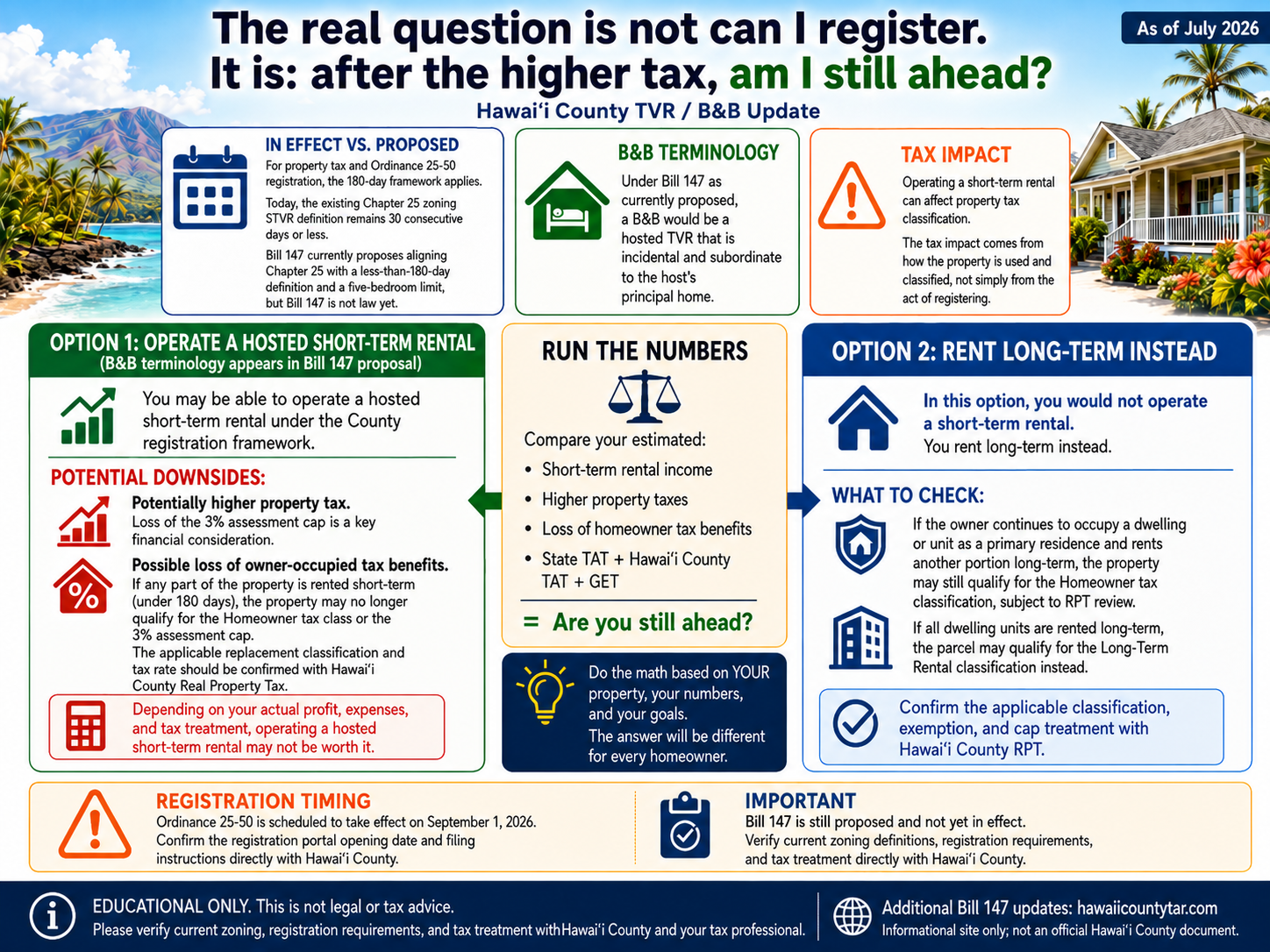
Lately almost every Big Island owner who runs a short-term rental has asked me some version of the same question, and I understand why. Three different things are being discussed at once, and in the news they tend to blur together.
Isn't short-term less than 30 days? When does it change to 180? Didn't the mandatory registration start last year? And why does everyone keep naming July 1, July 16, and September 1, as if one rule had three start dates?
They are actually three separate things, and keeping them straight matters, because a client is often making a real decision about their home. So rather than pass along a secondhand summary, I called the two offices that actually handle this (the Real Property Tax Office and the Planning Department) and confirmed the details firsthand.
Here is how they sort out.
Registration and zoning are not the same thing. Registration comes from Ordinance 25-50. It is mandatory for hosted and unhosted rentals under 180 days, the fees are $250 hosted and $500 unhosted, and the start date has moved twice, from December 2025 to July 1, 2026, and now to September 1, 2026. The portal is not even open yet. (The County Planning Department keeps the current details on its short-term rental page: https://www.planning.hawaiicounty.gov/resources/short-term-vacation-rentals)
The jump from 30 days to 180 days is a different question entirely. That is zoning (whether a short-term rental is allowed where your property sits at all), and it lives in Bill 147, still a proposal. It received a unanimous favorable recommendation from the Windward Planning Commission on July 2, and returns to the Leeward Planning Commission on July 16. From there it still needs more committee review and at least two council hearings, so it is not law yet. Today the definition is still under 30 days.
And here is the part that catches the most people: what actually counts as short-term. For registration, short-term means anything under 180 days. So if you have been renting for two months, or five, and assumed that counted as long-term and kept you out of all this, it does not. Once registration opens, it will be mandatory for you too. (There are property tax implications as well, but that is a separate conversation, and a good one to have with a tax professional.)
There is more on the horizon too. Two bills are set to come before Council committee on July 22. Bill 173 would create a new Bed and Breakfast homeowner tax class that keeps the 3 percent cap for homeowners who also run a B&B, along with a property tax amnesty period. Bill 175 would create a four-month grace period, making the registration window September 1 to December 31, 2026. Early proposals, not law.
I am not a CPA, and none of this is tax or legal advice. What I can tell you is this: confirm your specific parcel with the County Real Property Tax Office (https://hawaiipropertytax.com/) and sit down with a tax professional.
If you own a hosted rental here, has the uncertainty made you rethink whether it is still worth it? I would like to know how you are thinking about it.
Mahlo,



Let's Connect!